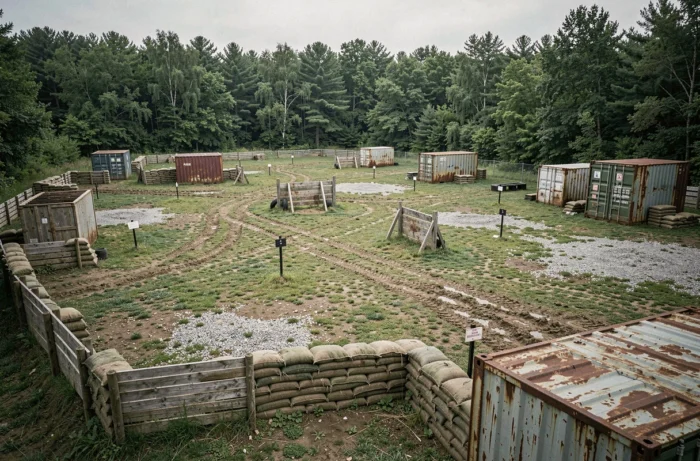
Airsoft attracts new players in France every year, supported by local associations and a handful of commercial operators. Creating a profitable airsoft field means balancing land-use, regulatory and financial constraints that most setup guides address separately. The legal structure you choose, the type of site you select and your business model all determine whether the project is viable—long before you install the first obstacle.
Insurance and business status: the issue many operators underestimate
Most airsoft fields in France operate as associations under the 1901 law. This structure works well for a group of enthusiasts sharing costs, but it becomes problematic as soon as you charge the public for entry.
An insurance policy taken out by an association generally covers its members and internal events. It may exclude commercial airsoft operations. Operators who charge for games should therefore obtain written confirmation from their insurer that the policy covers paid activities open to non-members.
If you want to set up a profitable airsoft field, your choice of legal structure (sole proprietorship, SARL, or an association with a commercial division) determines the scope of your insurance, your tax regime and your reporting obligations to URSSAF. Switching from an association model to a commercial one without updating your insurance policy could result in a claim being denied in the event of an accident.
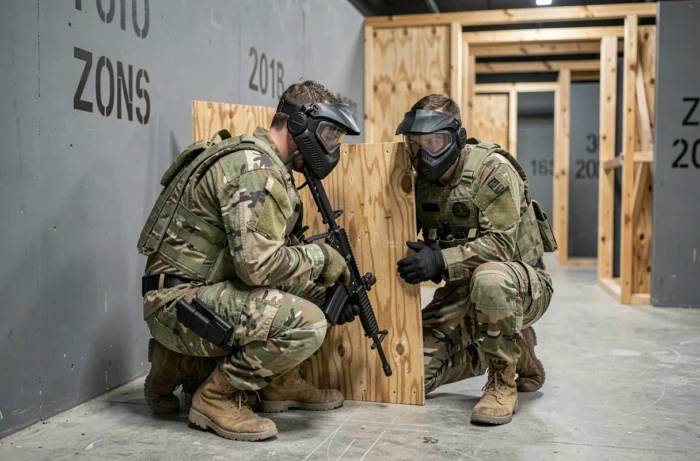
Indoor airsoft fields: the ERP question no one addresses early enough
An outdoor field in a forest or on disused farmland is subject to different requirements from an indoor site set up in a warehouse or former silo. As soon as a building is open to the public—even by paid invitation—it may fall under the regulations for establishments open to the public (ERP).
ERP classification depends on the venue’s capacity and the nature of its activities. It brings requirements for fire safety, accessibility and evacuation routes. Interior fit-out work (partitions, game structures, lighting) may require separate authorization, particularly if the building’s use changes from its original purpose.
Risk of administrative closure
A site can be shut down after several years of operation if no documented inspection was carried out before opening. A building that fails to meet fire safety or accessibility requirements could be subject to a municipal order prohibiting access.
For an indoor project, start by visiting the town hall to check the premises’ classification and the permits required. A documented inspection before opening helps prevent a later closure.
Occupancy agreement and securing the site
Many airsoft fields rely on a verbal agreement with a landowner, farmer or local authority. This arrangement works until the first dispute, accident or change of ownership.
A written occupancy agreement sets out the term, conditions of use, respective responsibilities and termination procedures. It also specifies who is responsible for restoring the site at the end of the occupancy period. Without this document, the operator has no guarantee of being able to stay on the site and no recourse if the owner ends the agreement without warning.
- The agreement should specify airsoft activities and whether the operation is commercial, to avoid any ambiguity with the owner and insurer.
- It should list the permitted improvements (earthworks, shelter construction, installation of modules) and any restrictions.
- A termination clause with adequate notice gives you time to dismantle installations and find another site.
Without a written agreement, an airsoft field remains a precarious venture.
Airsoft field layout: boost profitability by rotating game zones
A common mistake is to invest heavily in a fixed layout. Players who visit regularly can tire of a field with permanent obstacles arranged the same way after just a few months. Keeping players coming back means finding ways to refresh the experience.
Movable modules versus permanent structures
Pallets, barrels, camouflage netting and removable panels make it possible to reconfigure game zones from one week to the next. These modules cost little compared with permanent construction. A field that can be reconfigured builds player loyalty better than a static one.
Permanent structures (concrete bunkers, trenches, turrets) can help create a distinctive look and attract new players. The right balance is a few permanent focal points combined with mostly movable obstacles.
Reception areas and additional revenue
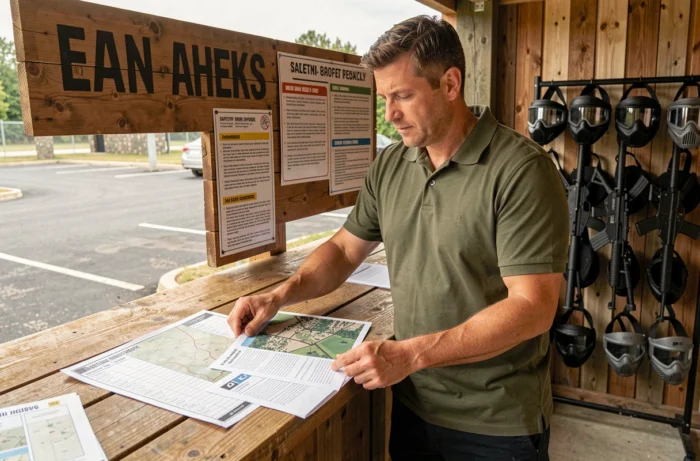
Profitability does not depend on entry fees alone. A well-designed off-field area with accessible parking, a covered briefing zone and a supply point can generate additional revenue through replica and protective gear rentals, sales of consumables (BBs, batteries) and private events for groups or businesses.
- Equipment rentals let you welcome casual players who do not own their own gear.
- Private events (team-building sessions, birthday parties) can be charged at a higher rate than open games.
- Posting house rules at the entrance and having every participant sign them reduces the risk of disputes and reassures insurers.
Additional revenue often accounts for a significant share of a commercial field’s turnover, sometimes more than entry fees alone.
Airsoft field safety: the requirements everything else depends on
Physically marking off the field with barrier tape, fencing and signs is the bare minimum. It keeps walkers from wandering into a game and clearly marks the play area for players themselves.
Beyond marking the boundaries, safety depends on checking replicas (with power limits set according to current standards), requiring eye protection and having at least one first-aid-trained organizer present at every session. Posting safety rules at the field entrance is not just cosmetic: it is one of the things checked in the event of an accident or claim.
A profitable airsoft field is not the one that attracts the most players in its first month. It is the one that secures its site, matches its insurance to its business model and refreshes its layout often enough to keep players coming back.