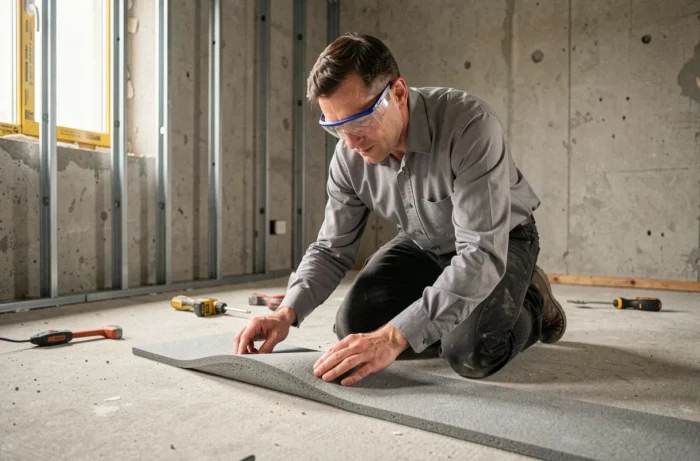
Choosing a Soniflex system to treat a party wall involves more than simply selecting an insulation panel from a catalogue. The final performance depends on the type of sound transmission, the configuration of the perimeter junctions and the thickness available for the lining. Choosing the right Soniflex press means thinking in terms of a system, not an isolated product.
Acoustic transmission assessment: identify the actual path of the noise
An on-site acoustic insulation measurement is the only reliable way to locate the path taken by the noise. A party wall may provide satisfactory sound reduction in laboratory tests while still allowing noise to pass through the floors, ceiling or adjacent cross walls. Flanking transmission skews the assessment as soon as you focus solely on the separating wall.
Soniflex offers panels for two installation methods: an independent lining or a bonded lining. Choosing one or the other without knowing whether the dominant noise is airborne, structure-borne or mixed is like treating a random symptom. Preliminary measurements determine the right product and thickness.
One often underestimated factor: when noise travels mainly through junctions (floor-wall, ceiling-wall), even a thick Soniflex press for party walls will only address part of the problem. The room must be treated as a complete acoustic volume, not as a flat surface to be lined.

Decoupled independent lining or bonded Soniflex lining: technical selection criteria
The decoupled independent lining provides the greatest sound reduction in the Soniflex range. The condition: no fixing point must mechanically connect the new wall to the party wall. Every screw or rail in direct contact creates an acoustic bridge that compromises the entire system.
Bonded lining, on the other hand, delivers lower performance than an independent framed lining. It is also poorly suited to uneven substrates.
When to choose an independent lining
- The wall is uneven or shows signs of damp that make reliable bonding impossible
- The noise to be treated is mainly structure-borne (impacts, structural vibrations transmitted through the building)
- There is enough space to lose several centimetres of thickness without compromising the room’s usability
When bonded lining is still a suitable option
- The existing wall is flat, dry and structurally sound, with a surface suitable for direct bonding
- The noise is mainly airborne (voices, television, music)
- The room is narrow and every centimetre of living space counts
For both configurations, the density and thickness of the Soniflex panel should be selected according to the target level of sound insulation. The greater the surface mass of the assembly, the better the sound reduction at low frequencies.
Air tightness and acoustic bridges: details that undermine Soniflex insulation
A correctly sized Soniflex system can lose a significant part of its performance because of installation defects. Sound passes through even the smallest gap. Incomplete perimeter joints, unsealed service penetrations and back-to-back recessed sockets in the party wall all reduce actual sound insulation.
The airtightness of the junctions is just as important to the result as the insulation panel itself. Flexible acoustic sealant must seal the connections between the lining and the ceiling, floor and cross walls. Resilient strips beneath the metal frame tracks complete the mechanical decoupling.
Electrical boxes are a common pitfall. Two sockets in the same position on either side of the party wall create an acoustic short circuit. When installing the Soniflex lining, offsetting the sockets and boxes from those in the neighbouring home eliminates this weak point.
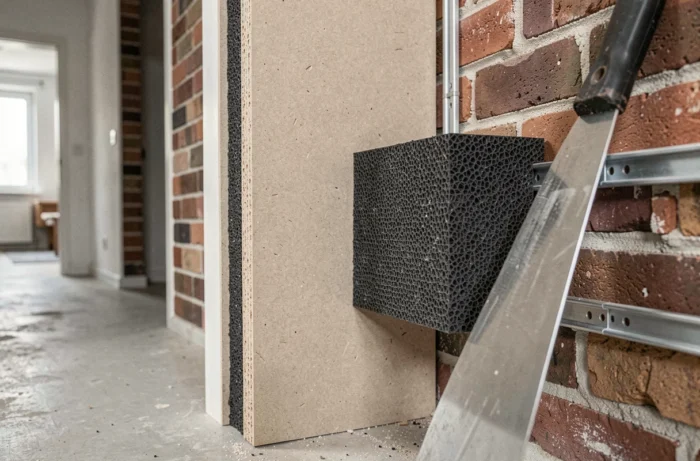
Party wall sound insulation: adapting your Soniflex choice to French regulatory requirements
In France, acoustic requirements for housing are governed by regulations. New homes must meet sound insulation thresholds between dwellings. For renovation projects, there is no regulatory obligation for owners to meet these thresholds, but case law on abnormal neighbourhood disturbances may require remedial work.
A preliminary assessment is important for property value as well as acoustics. Documenting the choice of Soniflex system with a before-and-after measurement report helps protect the property’s value in the event of a sale or dispute.
As for installation, the chosen solution must comply with best practices for dry construction: compliant fixings, preservation of the assembly’s fire resistance, and ventilation of the cavity where necessary. A poorly installed Soniflex lining can also compromise the fire safety of the party wall.
The final design takes three factors into account: the dominant type of noise identified during the assessment, the acceptable thickness given the available living space, and the target level of sound reduction. We recommend finalising these three variables in advance to avoid oversizing the system (higher cost, loss of space) or undersizing it (disappointing results). The Soniflex panel’s technical data sheet is no substitute for this overall assessment.