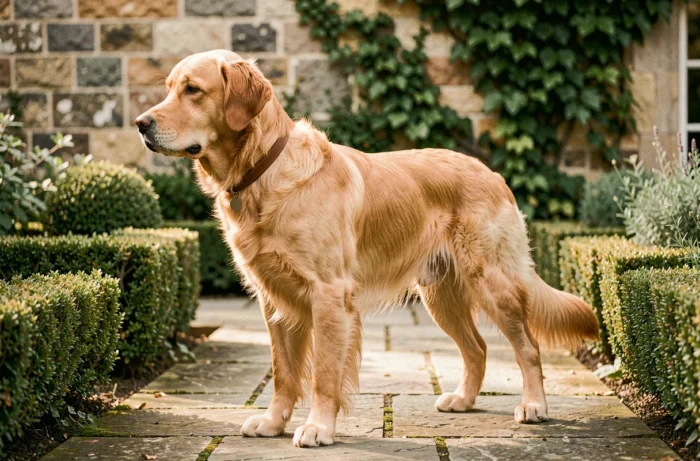
A dog that looks exactly like a German Shepherd is not necessarily a purebred dog. In France, this designation is based on a specific official document, not on the animal’s appearance. Understanding what a pedigree, the LOF and confirmation involve can help you avoid costly misunderstandings when buying a puppy.
Pedigree, birth certificate and LOF: three documents, three purposes
The French Stud Book (LOF) is the official genealogical register, recognised by the ministry responsible for agriculture. Every dog registered with the LOF has traceable ancestry within a given breed.
A birth certificate is issued when a puppy is born to two parents who are themselves registered with the LOF. This document confirms that the puppy has been provisionally registered. It is not yet a pedigree.
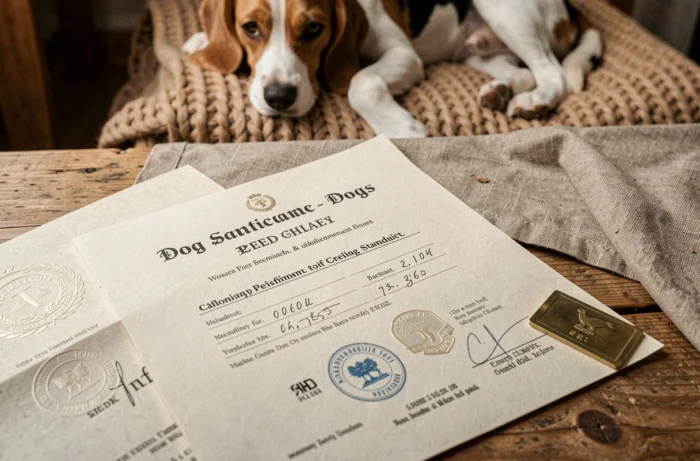
A pedigree is the definitive document, issued after an assessment known as confirmation. It lists the dog’s name, any kennel name, identification number (tattoo or microchip), ancestry across several generations and any titles earned. As the Société Centrale Canine explains, a pedigree serves as a genuine genealogical identity document. To learn more about the distinction between a purebred dog and a dog with a pedigree, the key difference lies precisely in this confirmation stage.
Without a definitive pedigree, a dog cannot legally be sold as a “purebred dog” in France, even if both parents are registered with the LOF. It must instead be described as a dog “resembling” or “of the type of” a breed.
Confirmation for purebred dogs: the step many people overlook
Confirmation is a feature specific to France. In most countries, registration in the stud book is enough to obtain a definitive pedigree. In France, an additional assessment is required.
An authorised judge assesses the dog at a canine event held in France. The aim is to check that the animal meets its breed standard in terms of morphology, teeth and gait, and has no disqualifying faults. Depending on the breed, dogs can be assessed for confirmation from 15 months of age; for some large breeds that mature slowly, the minimum age may be higher.
A dog that fails confirmation keeps its birth certificate but will not receive a definitive pedigree. Its offspring will not be eligible for LOF registration through descent either. This has direct implications for anyone considering breeding their dog.
Initial registration: an alternative route
In some cases, a dog with no known ancestry can be registered with the LOF through initial registration. This route is for dogs whose appearance matches a breed standard but who have no genealogical documents. Three breed experts must assess the dog and approve its registration. This process is longer and less common than registration through descent.
What a pedigree guarantees owners—and what it doesn’t
A pedigree certifies a dog’s genealogical identity. It confirms that the animal belongs to a traceable lineage and conforms to the breed’s physical standard. For a prospective owner, it provides assurance of origin and a degree of predictability regarding size, coat type and the general temperament associated with the breed.
A pedigree does not guarantee a puppy’s health. LOF registration does not require genetic testing or screening for hereditary diseases. A dog that has passed confirmation may carry transmissible genetic disorders that are not shown on the document.
Regardless of the pedigree, prospective buyers should ask the breeder directly to provide:
- The results of genetic tests carried out on both parents (screening for hereditary diseases common in the breed, such as hip dysplasia in German Shepherds or progressive retinal atrophy in Cockers)
- Health checks carried out on the puppy before sale (veterinary examination, vaccinations, deworming and, where appropriate, a cardiac ultrasound for breeds predisposed to heart conditions)
- Details of the breeding conditions: the puppy’s socialisation, the environment in which it was raised, and the number of litters per female per year
- A sales contract detailing the legal guarantees in the event of a latent defect or hereditary disease being detected after purchase
A reputable breeder will provide this information without being asked. If they cannot give a clear answer about the parents’ genetic tests, consider it a red flag, whatever the asking price for the puppy.
Genetic diversity and strict selection: a delicate balance
The drive to create new breeds registered in stud books has fragmented canine populations that were once closely related. Sometimes, relatively minor criteria—such as coat colour, coat length or eye colour—have been enough to divide breeding populations into distinct breeds, as the Alliance Canine Française points out.
Overly strict selection reduces a breed’s genetic diversity. When a small number of breeding dogs are used repeatedly, the risk of inbreeding rises, along with the prevalence of certain hereditary diseases. This is particularly an issue for breeds with small populations.
A pedigree makes this selection traceable, which is both its strength and its limitation. It allows breeders to pair dogs from unrelated lineages to maintain diversity, but it can also be used to breed closely related lines if the ancestry is not carefully analysed.
A dog of a breed type without a pedigree: a different choice
A dog “of a breed type” resembles a particular breed but is not registered with the LOF. It cannot take part in official dog shows or pass LOF status on to its offspring. However, a dog of a breed type can be just as healthy as a dog that has passed confirmation, and sometimes healthier if its parents have greater genetic diversity.
Whether to choose a dog with or without a pedigree depends on what you plan to do with it: breeding, showing, canine sports governed by the FCI, or simply keeping it as a companion.
Ultimately, the distinction between a purebred dog and a dog with a pedigree comes down to a rigorous administrative process specific to France. A pedigree protects a dog’s genealogical identity, not its health. Before buying a puppy, checking the parents’ genetic test results and the breeding conditions remain essential—things no official document can replace.