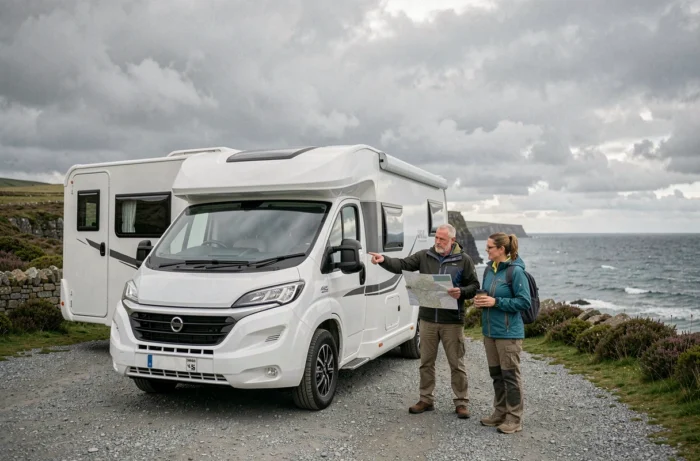
The Isle of Man, a self-governing British Crown Dependency in the Irish Sea, attracts visitors every year with its coastal roads, Victorian railway heritage and the famous Tourist Trophy races.
Getting to the island in a motorhome means relying on a single ferry operator, the Steam Packet Company, and following parking rules that differ considerably from those on the mainland. The Common Travel Area, which includes the Isle of Man, the United Kingdom and Ireland, simplifies some formalities, but does not eliminate them all for EU nationals.
Vehicle dimensions and Steam Packet ferry restrictions
The Steam Packet Company operates the only regular ferry services to Douglas, the island’s main port. Sailings run from Heysham (Lancashire) year-round, and from Liverpool or Dublin depending on the season. Before booking, check which vehicle dimensions are accepted on board.
Fares vary according to vehicle length, and slots for vehicles above a certain size fill up quickly. A standard low-profile motorhome can usually travel without difficulty, but large A-class motorhomes or van-and-trailer combinations may be an issue on some sailings. The company’s FAQ lists vehicle categories and applicable surcharges.
If you’re planning to explore the Isle of Man by motorhome, it’s worth checking the Steam Packet website directly for maximum permitted dimensions and boarding requirements rather than relying on generic information about British ferries.

Booking during the Tourist Trophy
The TT usually takes place in late May and early June. Vehicle spaces go on sale several months in advance, and demand far exceeds supply. Motorhome travellers hoping to visit during this period should keep an eye on when bookings open and be flexible about sailing dates. Slots for longer vehicles sell out first, well before foot-passenger tickets.
Outside the TT period, availability is generally good on most sailings, with lower fares and a less stressful boarding process.
Entry requirements for French visitors to the Isle of Man
The Isle of Man is part of the Common Travel Area (CTA), a free-movement zone between the United Kingdom, Ireland, Jersey, Guernsey and the Isle of Man. Travel is straightforward for British and Irish nationals. French and other European citizens should pay closer attention to the requirements.
Since the United Kingdom left the European Union, a valid passport is required to enter the CTA. A national identity card alone is no longer sufficient. The UK has also introduced the Electronic Travel Authorisation (ETA), an electronic travel authorisation system that is being rolled out gradually to different nationalities.
French nationals should check before travelling whether the ETA applies to them on their travel date. Requirements can change, so the official guidance published by the British and Manx authorities is the only reliable source. Assuming that taking the ferry from England means no formalities are required would be a mistake: the Isle of Man may carry out its own checks.
Motorhome parking on the Isle of Man: local rules to know
Articles about motorhome travel in the UK often focus on Scotland or England, but the Isle of Man has its own regulatory framework. The island does not simply apply British law: the Tynwald, the island’s parliament, passes its own legislation.
Wild camping is not generally permitted on the island. Parking a motorhome overnight outside designated sites can result in fines. Public car parks in Douglas and the main towns have height or time restrictions that make longer stays difficult.
Practical options for overnight stays
- Approved campsites, of which there are few on the island, are the safest option. Capacity is limited, so booking is essential during the TT and the summer months.
- Some farms and private properties informally welcome motorhome travellers by prior arrangement with the owner. These places are not listed on the major booking platforms.
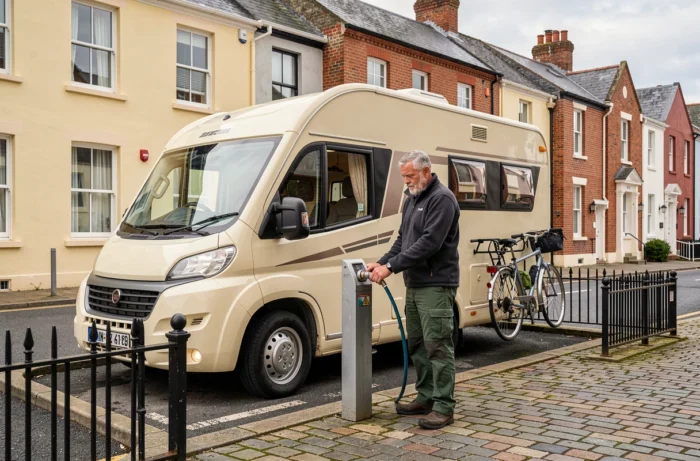
- Dedicated motorhome stopovers, like those found in France or Spain, are virtually nonexistent on the Isle of Man. There is no established network of service areas with electrical hook-ups and waste-disposal facilities.
This lack of dedicated facilities means planning each overnight stop in advance, especially if your vehicle is over six metres long.
Driving and Manx roads: hazards to watch out for
Traffic drives on the left, as in the UK. The island’s roads are narrow, often bordered by stone walls or tall hedges that restrict visibility. Driving a wide motorhome calls for constant care on the tight bends of rural roads.
One notable feature is that some roads on the island have no speed limit. The Mountain Road between Douglas and Ramsey is one such unrestricted section. This rule, inherited from the TT tradition, does not mean it is sensible to drive fast there in a motorhome. The vehicle’s high centre of gravity and the narrow road make excessive speed dangerous.
Petrol stations are concentrated around Douglas, Peel, Ramsey and Castletown. Fuel stops become less frequent outside these towns. Filling up before heading onto the roads in the north or west of the island helps avoid unpleasant surprises.
Vehicle autonomy and wastewater management
Without a network of service areas, managing fresh water and grey water depends entirely on the motorhome’s onboard capacity. Approved campsites generally have water points and waste-disposal facilities, but reaching them may sometimes require a detour.
Filling the tanks and emptying the waste before boarding the return ferry is the most practical precaution. On the English side, Heysham and the areas around Liverpool offer more options for finding a fully equipped service area.
The Isle of Man rewards travellers willing to work around its limitations: spectacular roads winding between moorland and cliffs, villages largely untouched by mass tourism, and a pace of life that feels different from more well-trodden destinations. The trade-off is that it takes more careful planning than a trip around France or even Scotland, where motorhome facilities have expanded in recent years.